

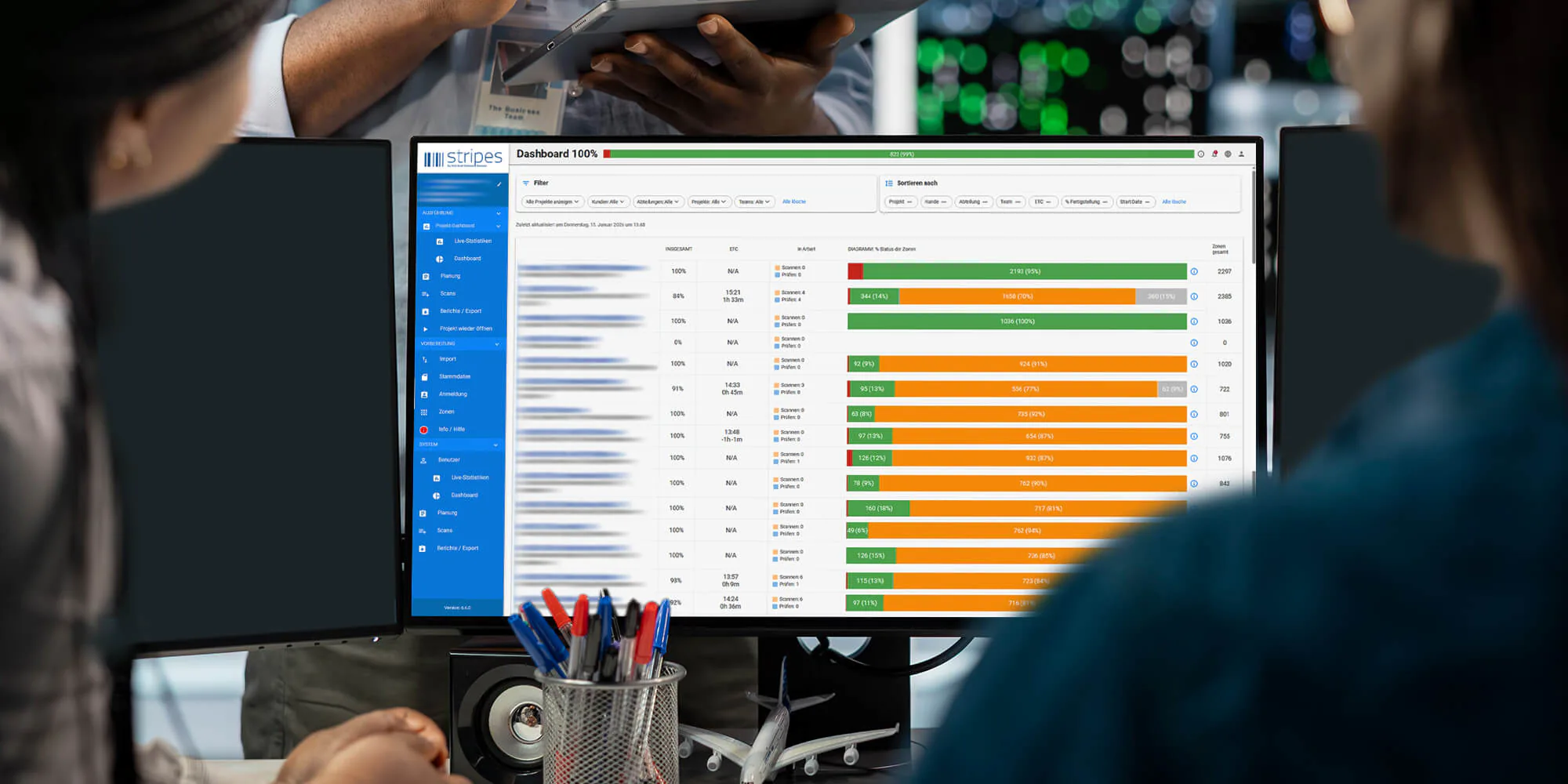
What is inventory management software?
Inventory software is a specialised software solution designed for the digital execution and management of stock-taking. It helps businesses with stock recording, the management of stock-taking processes, and the monitoring and analysis of count data. It is particularly useful in areas where stock is recorded on the move using scanners and where target and actual stock levels are systematically reconciled.
Translated with DeepL.com (free version)
1. Definition and legal framework
It is not the software that is required by law, but the stock-taking process itself. Under section 240 of the German Commercial Code (HGB), every trader must carry out a stock-taking at the start of their business and at the end of each financial year. Section 241 of the HGB permits simplified stock-taking procedures for this purpose. For tax purposes, a stock-taking carried out promptly—generally within ten days before or after the balance sheet date—is accepted.
Inventory software does not replace this obligation, but it does digitise the operational process. Instead of handwritten lists or isolated Excel files, items are uniquely identified by barcode, scanned on mobile devices, recorded in quantities and consolidated centrally. This is precisely why barcodes are so widespread in the retail sector: they make products automatically readable by scanners and reduce the need for manual data entry.
Unlike a traditional ERP or retail management system, inventory software focuses not on the day-to-day flow of goods, but on the planning, counting, monitoring and documentation of stock-taking. This is also important for continuous stock-taking, as tax regulations require documented stock management, at least one physical stock-take per year and traceable records.
2. What tasks does inventory management software perform?
Inventory software handles various tasks relating to the planning, execution, monitoring and analysis of stock-takes:
- Mobile data capture: Modern inventory software enables mobile, item-level stock recording. Items are usually identified by barcode, scanned directly on site and processed digitally without any additional intermediate steps. This helps to reduce manual input errors and consolidate inventory data centrally.
- Centralised management: Whenever multiple teams, devices or sites are involved in an inventory, centralised management is essential. Inventory software helps to manage scanners and users centrally, whilst keeping track of progress, status and ongoing counting processes across all sites.
- Quality assurance: Inventory software is not only used for data collection, but also for monitoring the quality of the inventory. Many systems support completeness checks, plausibility checks and the early detection of anomalies during the ongoing inventory process. In addition, features such as live monitoring or exportable reports are frequently used.
- Analysis and data transfer: Once the stock-take has been completed, it must be possible to process and analyse the data collected. This includes dashboards, reports and flexible export and interface options for exchanging data with other systems. It is important that the stock-take data can be provided in a structured and traceable format.
3. Why renting might make more sense than buying
A rental model can be particularly useful when stock-takes are carried out at fixed intervals or on a project-by-project basis. Cloud-based and pre-configured stock-taking software can often be deployed at short notice and, in many cases, does not require extensive installation work. For businesses that carry out regular branch stock-takes or recurring special counts, this can reduce the organisational and technical preparation required.
Other benefits include predictable costs and the ability to adapt flexibly to projects of varying sizes. Many cloud-based inventory management solutions can also be used without a constant internet connection and can be combined with suitable hardware where required. Thanks to the cloud-based system architecture, there is often no need for a dedicated on-premises IT infrastructure.
For many businesses, this is the key consideration: those who only carry out stock-taking on specific dates often do not need permanently licensed specialist software or their own fleet of devices. A rental solution is therefore particularly well suited to temporary stock-takes, seasonal peaks and projects of varying sizes.
4. What Stripes actually offers
With Stripes, we offer inventory management software on a subscription basis, designed for barcode-based, item-level tracking with real-time monitoring. The solution is cloud-based and can be used independently of existing ERP systems and without the need for a dedicated on-premises IT infrastructure.
The scope of services includes software access, project-specific configuration, and centralised monitoring and reporting functions. This includes, amongst other things, the management of users and roles, the integration of master data, the definition of workflows and counting rules, as well as project-specific customisations in line with the relevant requirements.
In addition, we provide a central dashboard that allows inventory processes to be monitored in real time. Progress, data quality and reports can be viewed and exported on an ongoing basis. This is particularly useful for managing large-scale inventory projects, branch structures and internal control processes.
Depending on the scope of the project, the inventory software can be combined with pre-configured inventory scanners and suitable accessories. Additional features include offline use, flexible configuration options, integrated quality controls, file-based data exchange and support for large fleets of devices.
5. Typical use cases
Inventory software on a subscription basis is particularly suitable for annual branch inventories with clearly defined timeframes, site roll-outs, expansions and project-based inventories carried out by service providers. Flexible provision of software and hardware can also be beneficial during temporary peak periods with a higher volume of counts.
For retail chains, centralised management across multiple sites is essential. For inventory service providers, the system’s independence from specific ERP software is beneficial, as projects, client systems and locations can vary. And if additional counting capacity is required at short notice, the necessary software and hardware can be scaled up on a project-by-project basis without the need to maintain dedicated resources on a permanent basis.
This makes inventory management software such as Stripes particularly suitable for businesses that wish to organise their stock-takes reliably without having to set up a permanent, bespoke solution for infrequent or seasonal tasks. Especially in the face of changing circumstances, the combination of short-notice availability, centralised monitoring and scalable hardware offers a practical advantage.
6. How the implementation works
The implementation is divided into four phases: first, requirements, processes and framework conditions are agreed upon. This is followed by a needs analysis, technical planning and, finally, operational implementation, including setup, a trial run and handover. The provider expressly emphasises that this process is designed to ensure rapid and smooth deployment with as little preparatory work as possible.
According to the provider, the implementation includes, amongst other things, user and role management, workflow definition, master data import and the setup of quality assurance. This is particularly relevant when multiple sites, changing teams or customer-specific counting rules need to be accommodated.
For businesses, this means that implementing inventory management software does not have to be a lengthy IT project. If the system architecture, product data and scope of the inventory are clarified at an early stage, the solution can be rolled out into live operation relatively quickly.
7. Frequently asked questions about Stripes
Here you will find answers to frequently asked questions about the features, applications and technical specifications of inventory management software, as well as Stripes’ rental model.
8. Conclusion
Inventory software helps businesses carry out stock-taking in a structured, traceable and efficient manner. It simplifies mobile stock recording, improves the management of ongoing stock-taking processes and ensures transparency in data analysis and quality assurance.
Cloud-based rental models can offer particular advantages for periodic, multi-site or project-based inventories, as they are flexible and can be adapted to different requirements. Solutions such as Stripes combine software, monitoring and, where required, suitable hardware within a single centralised system.