

1. Why the question of whether to buy falls short
Anyone looking for stock-taking software with integrated barcode scanning often thinks first of purchasing a permanent licence. For many companies, however, that is not the key issue. What is required by law is the taking of stock or inventory at the start of trading and at the end of the financial year – not the ownership of specialised software. At the same time, barcode scanning is now regarded as a tried-and-tested method for reducing manual data entry, speeding up data collection and improving accuracy compared to traditional, manual counting processes.
The more economically relevant question is therefore often: does the solution need to be purchased outright, or is temporary access sufficient? Modern subscription and cloud models reduce high upfront investments, enable scaling in line with demand, and shift rigid upfront costs more towards usage-based expenditure. This is precisely where a key advantage of the subscription model for inventory software lies: lower capital commitment combined with high availability.
1. Why the question of whether to buy falls short
For many retailers, stock-taking is not an ongoing project, but rather a process that takes place at regular intervals or on specific dates. This is precisely why a purely transactional approach often fails to reflect reality: usage is concentrated around stock-taking windows, branch stock-takes, rollouts or special counts – not necessarily throughout the year. Official descriptions of rental solutions for stock-taking therefore specifically cite annual branch stock-takes, project-based deployments and temporary peak periods as typical use cases.
From a business perspective, this is at the heart of the issue of capital tied up. Anyone who holds a traditional purchase licence, complete with infrastructure and reserve capacity, is financing capacity in advance – even if it remains largely unused outside of inventory periods. Rental and cloud models, on the other hand, rely on usage-based cost structures and flexible scaling. This allows high initial investments to be reduced and capacity to be provisioned as required. This is a particularly important argument against unnecessary capital tie-up, especially in the case of periodic inventories.
2. What inventory software with barcode scanning should be able to do
Good inventory software with integrated barcode scanning should not only be able to read barcodes, but also digitally map the entire inventory process. This includes mobile, item-level data capture directly at the stock location, centralised management of users, teams and devices, plausibility and completeness checks during the count, as well as reports and exports for analysis, auditing or further processing. It is precisely these functional groups that are described as standard in the product documentation of modern rental solutions for stocktaking.
Barcode scanning is a key factor in ensuring efficient and accurate stock-taking processes. By scanning barcodes, manual data entry can be reduced, data capture processes accelerated and the risk of errors minimised. For stock-taking, this means, among other things, clearer item allocation, fewer data discrepancies and faster access to count data.
3. Why the rental model is often the better choice financially
The main advantage of the subscription model lies in the reduced capital commitment. Instead of investing large sums upfront in licences, servers, scanners and spare capacity, companies using a subscription or access model pay recurring fees based on usage. This not only makes it easier to plan in terms of the balance sheet and budget, but also frees up liquidity, as less capital is tied up in specialist equipment that is rarely used. Rental and cloud models focus on flexible, on-demand usage rather than long-term upfront investments.
Added to this is the speed of deployment. Cloud-based inventory solutions are often pre-configured and can be rolled out at short notice. This significantly reduces the technical and organisational effort involved in implementation. For retailers with a tight inventory window, this is a practical advantage, as implementation does not have to turn into a major IT project.
Another economic advantage lies in scalability. Cloud and subscription models make it possible to flexibly adapt capacity to actual demand. This is exactly what inventory management requires: sometimes only a few devices and users are needed, whilst at other times a large number are required simultaneously. Subscription models for inventory management software therefore offer predictable costs, flexible project sizes, temporary additional capacity, and the advantage of not having to maintain your own hardware infrastructure on a permanent basis.
4. In which situations is renting particularly sensible?
Renting is particularly useful whenever demand is irregular. Typical examples include annual branch inventories with tight timeframes, site rollouts and expansions, project-based inventories carried out by service providers, and peak periods when additional scanners, users or counting capacity are required at short notice. These scenarios are explicitly cited as typical areas of application in market documentation on inventory rental models.
The underlying pattern is always the same: it is not round-the-clock availability that is the bottleneck, but rather reliable peak availability. It is precisely in this scenario that the rental model really comes into its own. Official provider descriptions refer here to scalable solutions for branch networks, seasonal peaks, changing projects, and the ability to avoid maintaining in-house equipment fleets or making hardware investments. For companies that only carry out stock-taking on specific dates, this is often the more cost-effective way to organise things.
5. What a Practical Rental Model Actually Includes
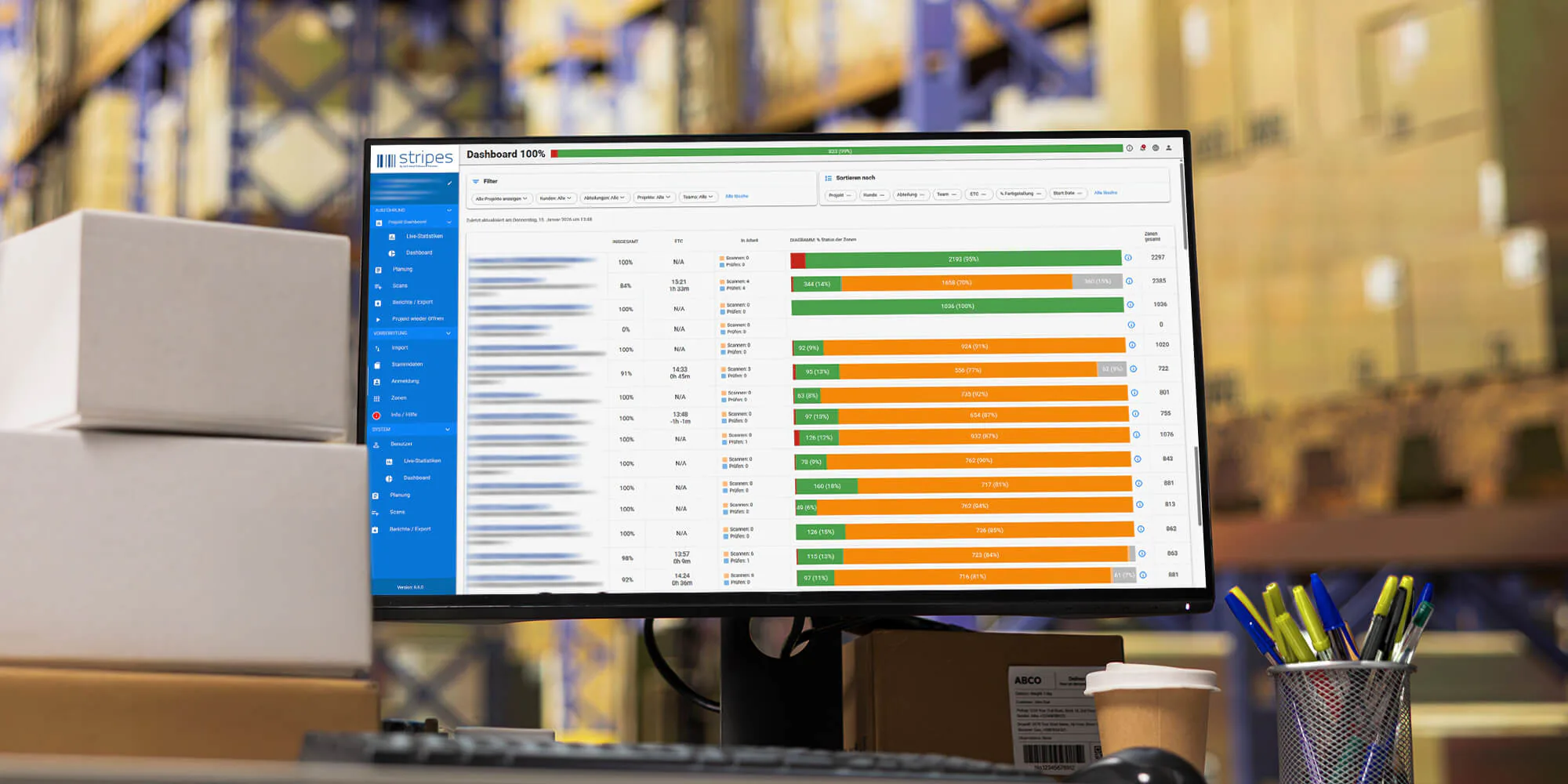
When choosing inventory management software with barcode scanning, you don’t necessarily have to make a permanent purchase. Stripes offers inventory management software on a flexible subscription basis, which is ideal for periodic or project-based stock-taking.
In addition to software access, the rental model also includes project-specific configuration, monitoring, reporting and, if required, preconfigured scanner hardware. The cloud-based solution operates independently of ERP systems and is designed for barcode-based, item-level inventory recording with live monitoring. Furthermore, the software can also be used in areas without a permanent internet connection.
In practice, it is precisely this integrated approach that makes all the difference. With Stripes, businesses receive not just inventory management software, but a comprehensive solution tailored to their specific inventory processes. This includes ERP-independent cloud software, real-time monitoring, quality assurance, flexible services and – where required – pre-configured inventory scanners. The solution can be scaled to meet specific needs and enables companies to reduce investment in their own hardware and flexibly adapt inventory costs to actual usage.
6. Conclusion
Inventory software with integrated barcode recognition can, in principle, be purchased as a traditional perpetual licence. For many companies, however, this is not the most convincing solution to their actual needs. Barcode scanning improves data capture and helps prevent errors, whilst rental and SaaS models reduce upfront investment, make costs more predictable and provide capacity exactly when it is needed. Particularly for periodic, multi-site or project-based inventories, it is therefore not ownership of the software that is the bottleneck, but rather fast, precise and flexible access to it. Anyone who takes this logic seriously will often find that, when asking ‘Where can I buy?’, a rental model makes the most sense – and that is precisely where its business advantage lies.